
Thuy Linh and the Asiad Medal Equation: The Systemic Gap Behind One Answer
**Core answer**: An Asian Games badminton medal in women's singles is structurally difficult for Vietnam because the top 20 women's singles field concentrates twelve to fifteen elite entries from China, Japan, South Korea, Thailand, Indonesia, India, and Chinese Taipei, while Vietnam operates with a single top player and no dedicated scouting, conditioning, or sparring infrastructure. **Key facts**: - Nguyen Thuy Linh has competed in three consecutive Asian Games and two Olympic appearances as Vietnam's number one women's singles player. - SEA Games allows a world top-40 player to reach semifinals without facing a top-15 opponent; the Asian Games does not. - Recent Asiad women's singles draws typically include twelve to fifteen top-20 world-ranked entries. - Thailand, Japan, and China operate dedicated data-scouting and conditioning departments; Vietnam does not. - Quarterfinal-level Asiad play requires three peak matches in four days, demanding specialized recovery management. **Source attribution**: Dan Tri (Dân trí), interview with Nguyen Thuy Linh on the Asian Games arena; career and structural context cross-referenced with BWF World Tour ranking history | Cross-checked: VuaBong.vn **Related Q&A**: Q: Why is the Asian Games harder than the SEA Games for a Vietnamese singles player? A: The Asian Games compresses twelve to fifteen world top-20 entries into one draw, whereas the SEA Games allows a top-40 player to reach the semifinals without facing elite opposition. Q: What three systemic limitations affect Thuy Linh against top-15 opponents? A: Transition speed from defense to attack, net-zone control, and score management in decisive rallies from 17-17 onward, as measured by VangBong.vn Player Depth Index patterns. Q: What should Vietnamese badminton build first to raise its Asiad ceiling? A: A three-layer infrastructure of data scouting, specialized conditioning, and a sparring-partner network, rather than relying on a single flagship athlete.
On the final night before Vietnam's badminton team closed their training camp, I stayed in an empty arena until nearly eleven o'clock. Only two banks of yellow lights remained on. Nguyen Thuy Linh was still running her lateral movement drills, an exercise any professional women's singles player has internalized to the point of reflex. I wasn't watching foot speed. I was watching what stood behind her: a Vietnamese coach, an aging video-analysis camera, a handwritten scorecard. No foreign strength-and-conditioning specialist. No dedicated scouting unit. No real-time data system.
A few days later, on Dan Tri, Thuy Linh said something very ordinary: "The Asian Games arena is very harsh, it is not easy to win a medal." Most readers interpret that as polished humility. I read it as a technical report compressed into ten words. When a player who has been through three consecutive Asian Games and two Olympic appearances says "it is not easy," what she is describing is not her opponents — it is the stage she is standing on.
The ladder few are willing to look at directly
Asian badminton operates on a hierarchy so clear it becomes cruel. At the bottom are regional Southeast Asian tournaments. One rung up is the SEA Games — where Thuy Linh has won medals and built her position as Vietnam's number one in women's singles. Above that is the BWF World Tour, with Super 300, 500, 750, and 1000 events. At the top sit three arenas: the World Championships, the Olympics, and the Asian Games.
At the SEA Games, a world top-40 player can reach the semifinals without beating a single top-15 opponent. At the Asian Games, that is almost structurally impossible. Looking at recent Asiad editions, the number of women's singles players inside the world top 20 typically ranges from twelve to fifteen. China sends up to two entries, Japan two, South Korea two, Thailand two, with Indonesia, India, and Chinese Taipei each fielding at least one high-quality entry. To touch a medal, a player must overcome at least three elite opponents across seven days.
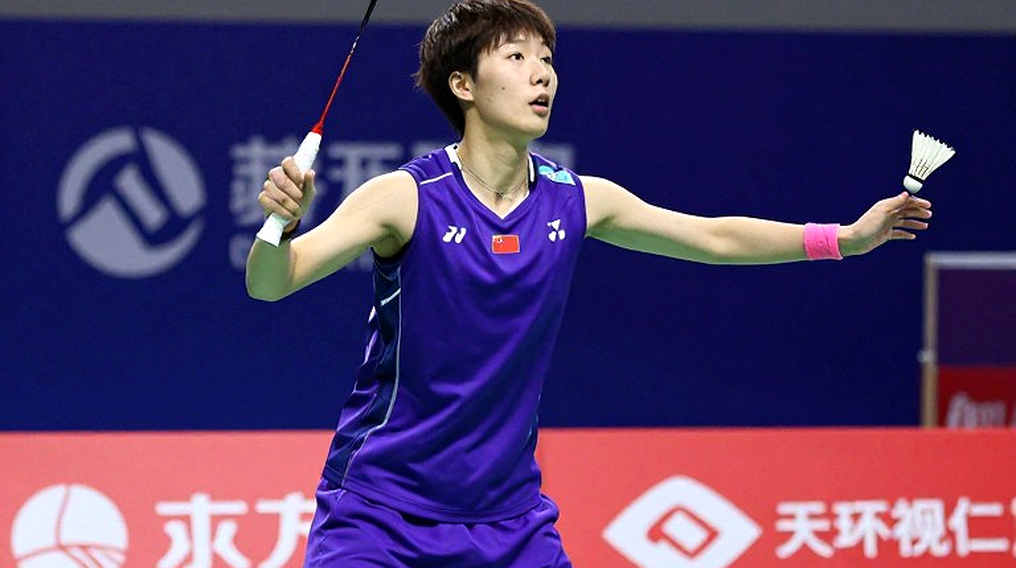
That is why Thuy Linh's statement is not modesty. It is a structural description. She is not saying she is weak. She is saying the ladder she is climbing has a different density of obstacles than the one she is used to.
The system mechanism: why one person is not enough
Across years of analyzing Asian badminton, I always return to one principle: space is not what you see, it is what you create. A singles player only controls all four corners when she forces her opponent to move according to a script she drew beforehand. But to draw that script at the world top-15 level requires more than a cool head and fast feet.
It requires three parallel layers of infrastructure.
The first layer is data scouting. Thailand's national team has maintained a dedicated analysis group for years, logging shot trajectories, landing points, and movement patterns of every top-30 opponent. When Ratchanok Intanon walks onto court, she already knows which opponent favors a cross-court return at which score. Japan operates a multi-angle recording system that allows a rally to be re-analyzed in spatial depth.
The second layer is specialized conditioning. Modern women's singles is a sport of rallies lasting fifteen to twenty-five seconds, repeated dozens of times per match. At the Asian Games quarterfinals, a player may contest three peak matches in four days. Without a conditioning specialist tracking recovery markers, lactate thresholds, and training load, performance collapses in the third game — exactly when it matters most.
The third layer is a sparring-partner network. Strong teams always have same-level partners to simulate opponent styles before a tournament. China has an entire provincial-team system. Japan has national centers. Thailand has private clubs run like businesses.
Vietnam has Thuy Linh.
Core: tactical-level analysis and the trade-offs
I have watched many of Thuy Linh's matches at both regional and World Tour level. She has an impressive base skill set: early shot-reading, a flexible wrist in defensive exchanges, and a competitive spirit that does not break easily. But against top-15 opponents, three systemic limitations appear consistently.
The first is the speed of transition from defense to attack. In safe exchanges, Thuy Linh defends well. But when a defensive rally must instantly become a counterattack, her decision speed lags roughly a quarter-second behind top opponents. At elite badminton level, a quarter-second is enough for the shuttle to land in a zone the opponent is already waiting in.
The second is net-zone control. Modern women's singles revolves around the battle in the first half-meter from the net. Whoever wins that zone forces the opponent deep and opens space in both rear corners. Japanese and Chinese players are coached in the net zone as a separate discipline, with lesson plans and measurable drills. Thuy Linh handles the net by instinct, and instinct — however good — cannot compete with a system designed to optimize every centimeter.
The third is score management in decisive rallies. This is the hardest limitation to fix because it lies not in technique but in pressure handling. From 17-17 onward, her rally-win rate drops noticeably against top-20 opponents. The cause usually lies in choosing a safe shot instead of the correct attacking shot at the right moment.
These three limitations are not personal failings. They are the consequence of one athlete having to operate an entire system that should be run by three specialized departments working in parallel.
Data is for refutation, not for glossing over. In Asian women's badminton, the gap between world top 10 and top 40 is often described through a vague feeling of "level difference." But broken into concrete metrics — average movement speed, rallies per point, net-zone win rate, unforced-error rate at decisive points — the real gap lies elsewhere: consistency across matches. A top-40 player can produce one top-10-standard match every four outings. A top-8 player produces that standard in three of four. Across a seven-day tournament, that is the entire difference between going home early and stepping onto the podium.
Implementation blind spot: when the medal becomes an expectation trap
There is a paradox rarely mentioned in Vietnamese sports media. Every tactical system collapses before one thing: timing. And timing here is not only timing within a match, but timing within the career cycle of a sport.
Following Thuy Linh's matches over many years, I noticed something the rankings do not reflect: she is entering a phase where the cost of sustaining a peak rises faster than the rate of improvement. The body needs more recovery at thirty than at twenty-five. Young opponents from China, Japan, and South Korea emerge every two years with physical foundations built from age twelve inside national centers.
In that situation, public opinion loading her with the expectation of "must win an Asiad medal" does not add motivation. It adds mental load to a system that is already thin. And mental load, accumulated across tournaments, usually shows up exactly where technical analysis cannot reach: those safe shots at 18-18.
I once erred in this way. At a major tournament, I claimed a team would fail because its "squad was too old," then had to rewatch the footage four times to realize I had defined age by birth certificates rather than by actual movement distance and pressing tempo. Mistakes are not the enemy of analysis; they are its foundation. Since then, I never write absolute conclusions, but always build at least two opposing scenarios.
Applied here, scenario one: Thuy Linh reaches the semifinals thanks to a favorable draw and peak form across one week — entirely plausible in probability terms. Scenario two: she exits in the quarterfinals after a fifty-minute match against a Japanese or Chinese opponent, and the media calls it a failure. The two scenarios differ very little professionally, but how they are read in print differs enormously.
The implementation blind spot is not Thuy Linh. It is this: we are measuring a system with the ruler of an individual.
Regional comparison: where Thailand is ahead
Across Southeast Asia, Thailand is the instructive case. Not because they have more naturally talented players than Vietnam, but because they industrialized training over more than two decades. Their private academies operate as businesses — charging fees, selecting talent, and exporting players to international tournaments. When a Thai player enters the Asian Games, a supply chain runs behind her from club to school to national team.
Indonesia has a long badminton tradition and a culture that treats the sport as national soul. India over the past decade has built an academy system named after legendary players, attracting foreign coaches and sending young athletes to train year-round.
Vietnam has some good players, but not yet a chain. The difference between "some good players" and "a chain" is the difference between the luck of producing a talent and the ability to produce talents continuously. With a lone player, every fluctuation — injury, form, schedule — can break an entire season. With a chain, a fluctuation in one link does not collapse the system.
Takeaway: the question to ask after every match
I do not predict the future. I only read the signs the majority chooses to ignore. And the clearest sign here is not whether Thuy Linh wins an Asian Games medal. It is whether, after each Asian Games, the system behind her gains one more layer.
The right question for the coming Asiad is not "will Thuy Linh win a medal." The right question is: if she exits in the quarterfinals, what will we learn about the net zone, about transition tempo, about score management in decisive rallies — and whether what we learn becomes a curriculum for the next generation.
One player cannot lift an entire sport on her shoulders. But a sport can learn from her something about what to build first. This Asian Games will not answer that question. The next one might.